
Biological Compost Types: Choosing the Right Compost for Your Project
By Colleen Dempster, 2026

Compost Microbiology Matters
Plant communities undergo succession — predictable changes in plant species over time as soils develop. Early-successional plants thrive in disturbed conditions. As soils stabilize, longer-lived and more diverse plant communities establish.
Below ground, the soil microbial community is also changing. Disturbed soils are typically dominated by fast-reproducing bacteria. As disturbance decreases, fungal networks develop, organic matter accumulates, and higher trophic organisms such as protozoa and nematodes become more abundant (Figure 1). These microbial shifts strongly influence which plants are able to thrive.
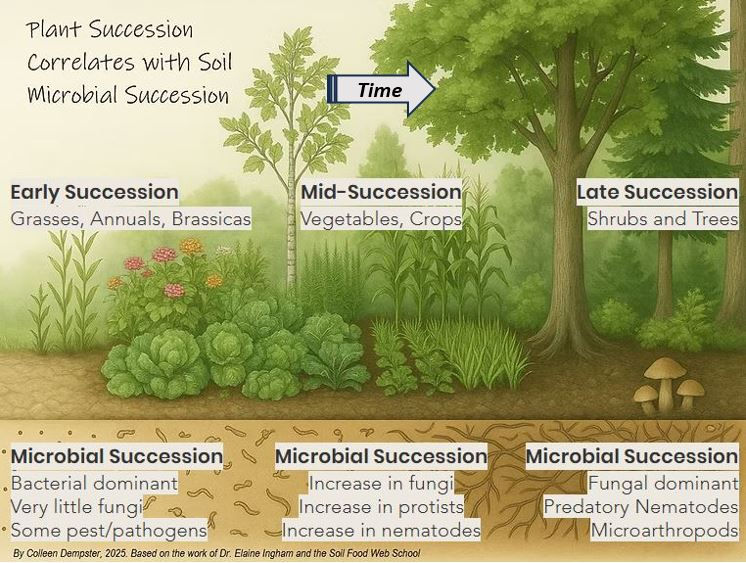
Figure 1. The conceptual relationship between plant succession and soil microbial succession, illustrating increasing fungal biomass and trophic complexity from early- to late-successional systems.
Compost undergoes microbial succession as well. As compost matures, its microbial community typically shifts from bacterial-dominant to increasingly fungal and trophically complex — provided moisture, aeration, and carbon inputs are maintained. Because this process occurs much faster in compost than in soil, composts of different ages and management histories can represent very different stages of microbial succession.
This matters because compost is often used as a biological inoculant, including in the form of liquid biological amendments such as compost teas and extracts. These amendments are applied with the expectation that they will introduce beneficial microorganisms, improve soil health, and support the growth of desired plants. When compost biology does not align with the successional needs of the plants being grown, inoculation efforts may be ineffective or short-lived.
For example, a bacterial-dominant compost applied to a system that relies on fungal pathways will not create fungal dominance. Likewise, compost lacking protozoa or nematodes cannot establish trophic complexity, regardless of how or when it is applied.
Understanding compost biology shifts the focus from how compost is applied to whether it is biologically appropriate in the first place.
Why This Matters for Growers
For growers using compost as a biological tool, selection matters as much as application. Compost type, certification status, or appearance alone are poor predictors of biological function.
When compost is used intentionally, it should be evaluated based on microbial compositionmatched to the successional stage of the plants being grown. With this context established, composts can be examined along a microbial successional gradient to define functionally distinct biological compost types.
For example:
Golf-course managers are managing turf, a bacterial-dominant system, where a clean, pathogen-free, bacterial-dominant compost may be appropriate.
Home gardeners and market (flower or vegetable) growers are managing more diverse plant communities, which benefit from composts with a broader suite of soil food web organisms.
Vineyard, orchard, and tree growers are working in late-successional systems, where fungi — both saprophytic and mycorrhizal — are essential, and fungal-dominant composts are most appropriate.
How, then, can growers determine which compost type suits their project?
Using a microscope — or seeking a professional microbial analysis — is the most direct approach. When this is not possible, understanding how a compost was made, cured, stored, and handled, and comparing that information to the patterns observed in this study, can help infer its likely position along the microbial successional continuum.
This article synthesizes 61 Soil Food Web microscopy assessments conducted by Rewild Soils Lab between 2022 and 2025. To reflect how compost is encountered in practice, samples were grouped into three easily recognizable categories based on production method:
Home-made thermal aerobic composts (sample size, n, = 32)
Commercial thermal aerobic composts (n = 19)
Vermicomposts (both home made and commercial) (n = 10)
Each sample was evaluated for:
bacterial biomass
fungal biomass
fungal-to-bacterial (F:B) ratio
beneficial protozoa
beneficial nematodes
Together, these metrics allow composts to be positioned along a microbial succession continuum, from early- to late-successional communities.
Results
Figures 2 – 6 show microbial abundance (µg/g) and F:B ratio of the main beneficial microbe groups, further grouped by compost category.

Figure 2. Bacterial biomass (µg/g) of three compost categories: Home-made, Commercial, and Vermicompost. Sample size is 32, 19, and 10, respectively.

Figure 3. Fungal biomass (µg/g) of three compost categories: Home-made, Commercial, and Vermicompost. Sample size is 32, 19, and 10, respectively.

Figure 4. Fungal to Bacterial biomass ratio of three compost categories: Home-made, Commercial, and Vermicompost. Sample size is 32, 19, and 10, respectively.

Figure 5. Number (per gram) of beneficial Protozoa (flagellates and amobae) of three compost categories: Home-made, Commercial, and Vermicompost. Sample size is 32, 19, and 10, respectively.

Figure 6. Beneficial Nematodes of three compost categories: Home-made, Commercial, and Vermicompost. Sample size is 32, 19, and 10, respectively.
Choosing the Right Compost (a Successional Perspective)
1. Commercial Thermal Aerobic Composts
Commercial composts are widely available, consistent, and often certified (e.g. organic). They are commonly used across agriculture, landscaping, and turf management.
In this dataset, commercial composts most often exhibited low fungal biomass, low F:B ratios, and limited populations of protozoa and nematodes. This biological profile is consistent with early-successional microbial communities.
These patterns align with typical commercial compost production methods, which often include frequent mechanical turning, screening, drying, extended storage, and exposure to ultraviolet radiation. These processes disproportionately affect fungi and higher trophic organisms, while bacteria tend to recover quickly.
Best suited for:
grasses and turf
brassicas
annual cropping systems
frequently disturbed soils
Commercial composts still provide significant value. Their strengths lie in availability, affordability, consistency, certification status, and their contribution of organic matter and nutrients. However, when used specifically as a biological inoculant, they are generally poorly suited to perennial, woody, or late-successional plant systems.
2. Home-made Thermal Aerobic Composts
Home-made composts showed the widest range of microbial communities in this dataset, spanning early-, mid-, and late-successional stages.
Well-managed home-made composts often exhibited higher fungal biomass, more balanced F:B ratios, and more consistent presence of protozoa and beneficial nematodes. This reflects longer curing periods, better moisture retention, reduced disturbance, and more diverse feedstocks.
Because management practices vary widely, home-made composts are not biologically uniform. Some resemble early-successional systems, while others develop into highly fungal and trophically complex communities.
Best suited for (depending on biology):
vegetable gardens
diversified cropping systems
productive pastures
perennial plantings
soil restoration projects
Home-made composts are often produced in smaller batches and may be more variable and less likely to carry formal certifications. However, they offer the greatest potential for biological diversity and successional alignment when managed intentionally.
3. Vermicomposts (Home-made and Commercial)
Vermicomposts occupied an intermediate and highly variable position in this study. Some samples were bacterial-dominant, while others exhibited moderate to high fungal biomass and more complex trophic structures.
Some of this variability reflects whether a compost was home-made and unseived, versus commercially made, where home made showed greater moisture levels and higher protozoan and nematode counts (however the sample size was extremely small for home-made vermicompost). Still, some commercially available vermicompost showed very high fungal counts. Vermicomposting does not inherently produce a fungal- or bacterial-dominant product; biological outcomes are highly dependent on feedstock, moisture management, and post-processing.
Vermicompost is best suited for:
high-value crops
vegetable and flower systems
biologically active soils
targeted biological supplementation
Vermicomposts can be biologically powerful but should not be assumed to match any particular successional stage without evaluation. Microscope analysis is recommended upon purchase/use of any vermicompost.
Putting It Together
Across the 61 samples:
Commercial composts most often aligned with early-successional systems
Home-made composts spanned the full successional spectrum
Vermicomposts were highly variable and management-dependent
Compost source alone did not determine compost biology. High- and low-performing composts occurred in every category. Successional interpretation provides the missing link between compost type and plant needs.
Compost is not biologically generic. It has a history, a trajectory, and a function.
Viewing compost through the lens of microbial succession allows growers to move beyond labels and infer what a compost is biologically capable of supporting. Matching compost microbial communities to plant successional needs is a practical and powerful way to improve soil function, plant performance, and the reliability of biological inoculation strategies.
Find more and support my work on Patreon: Rewild Soils Lab
Comments